Work that delivered
Tap any project to open the full case study.
Ecommerce Rebuild & Product SEO
A B2C ecommerce catalog that couldn't be found. Product pages are the money pages — and the ones most often left with manufacturer boilerplate, thin copy, and no keyword intent — so the store ranked for its own brand name and little else. This was a discovery problem, not a traffic one: the site was invisible to the people searching for exactly what it sold, and those buyers were checking out somewhere else.
Two workstreams, deliberately separated so each could be measured on its own. The rebuild turned existing traffic into revenue — site structure, product-page layout, and the path to checkout. The SEO program earned new, non-brand traffic through a repeatable template applied across the entire catalog, rather than hand-tuning a handful of hero products. Tracking them as separate outcomes kept the measurement honest.
- New product-page template with keyword mapping behind every page
- Titles and metadata restructured across the full catalog
- Internal linking between related products and categories
- Site-speed improvements and structured data
- Product keywords woven into an ongoing blog program
- Abandoned-cart email flows to recover lost checkouts
Organic Instagram Growth
Instagram is A. Cakes' primary acquisition channel, and by early summer the account had gone flat. It still got views, but almost all of that reach landed on existing followers — the content was circulating inside an audience that had already decided how it felt about the brand. The month before any changes, only 58.8% of views came from non-followers and the account added just 14 net followers. The problem wasn't content quality; it was distribution. For a business where a booking is worth a significant amount and the buying window opens 9–18 months before the wedding, an account that only talks to its existing audience isn't doing its job.
I set the goal as cold reach, not followers — followers are a lagging number; reach is the one you can actually influence. Get the content in front of people who'd never seen the brand, give them a reason to follow, and the follower count takes care of itself. That broke into three decisions: concentrate on the format Instagram was actually distributing (Reels) instead of spreading effort evenly; build a real content calendar to publish consistently and learn what worked; and give new visitors a specific reason to follow — because reach without a follow is just a view.
- Built a monthly content calendar — set the cadence, mapped concepts ahead, and batched production so the account never went quiet in busy weeks
- Shifted the mix toward Reels and produced for discovery — the opening seconds had to land for someone who'd never heard of the brand
- Pulled back on Stories, which only reach existing followers and were absorbing time needed elsewhere
- Reworked what a new visitor sees on the profile so there's a clear reason to follow, not just a nice grid
| Metric | Before | After | Change |
|---|---|---|---|
| Accounts reached | 8,909 | 31,633 | +255% |
| Views | 32,359 | 70,060 | +117% |
| Interactions | 1,202 | 3,369 | +180% |
| Net followers | +14 | +83 | 5.9× |
- The format shift did the work. Reels grew from 13K to 54K views (~4×) while Posts held flat and Stories fell — Reels went from 40% to 77% of all views. The gain came from reallocating effort to one format, not posting more everywhere.
- It broke past the existing audience. Non-follower views rose from 58.8% to 76.6% — cold reach went from ~19,000 to ~53,700 views. That was the actual problem I set out to solve, and the number I'd point to first.
- Engagement rose while reach expanded. Interactions per view went from 3.7% to 4.8% (+30% relative) — the opposite of the usual pattern when an account breaks into cold audiences.
- The profile converted better per person. Follow rate per account reached went from 0.16% to 0.26% (~+67%) — credit to the profile and follow-reason work, measurable separately from the content.
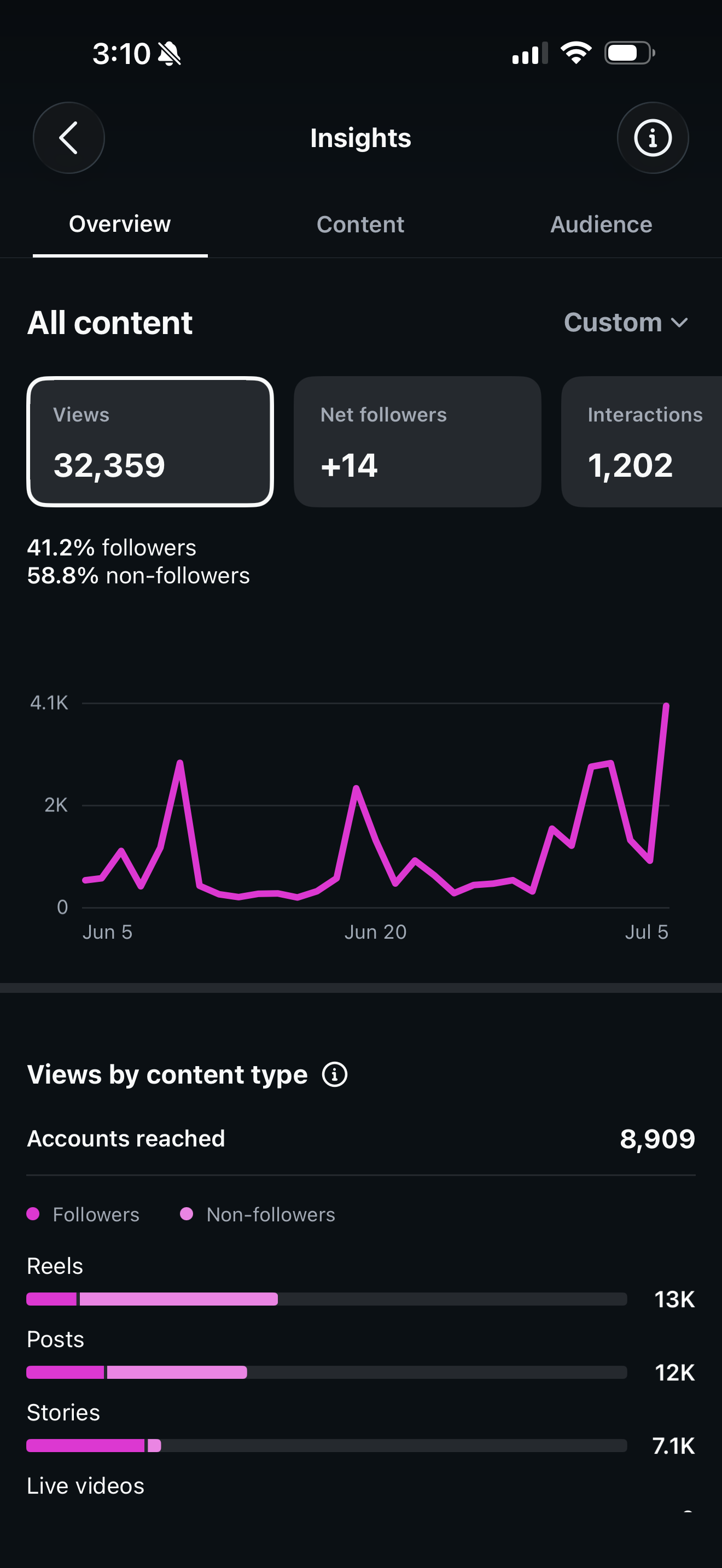
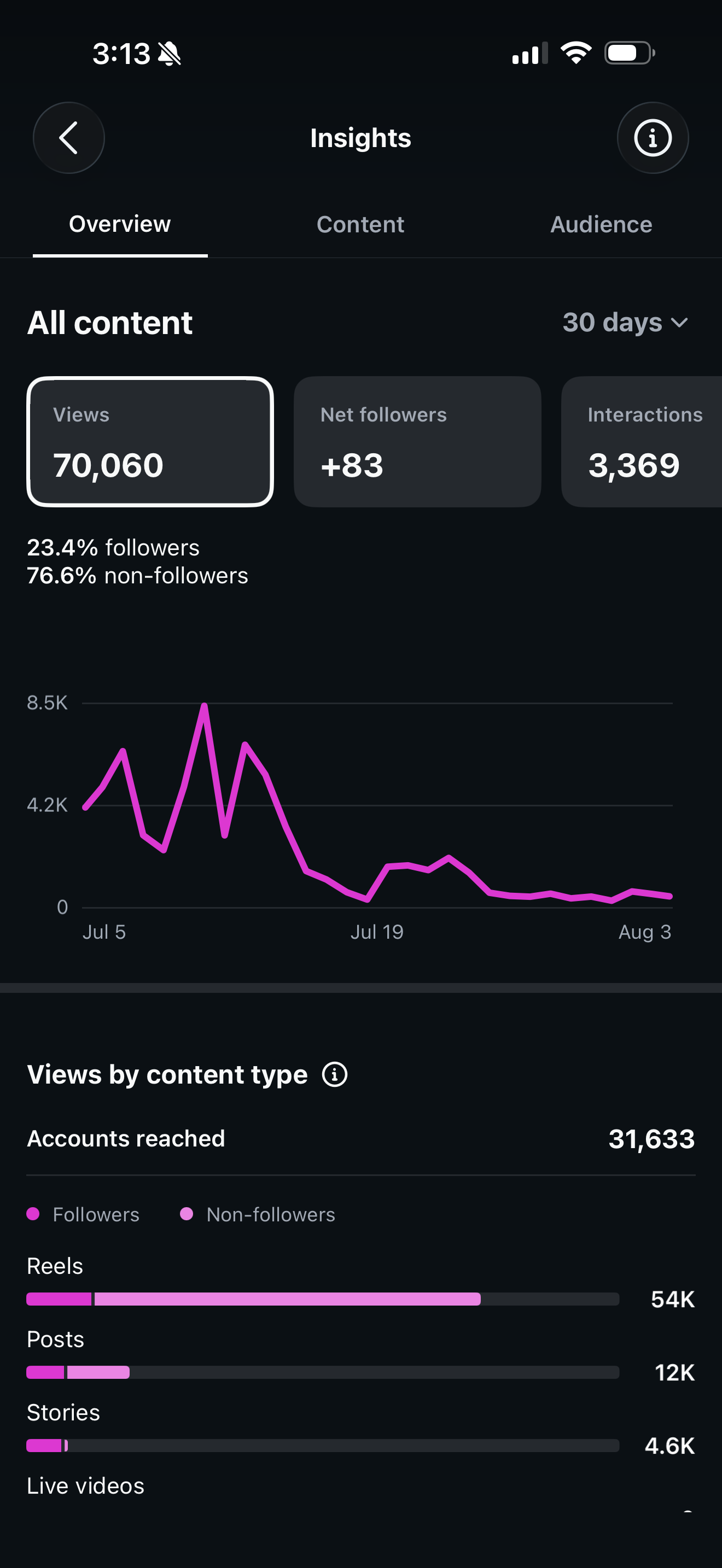
Instagram Insights, straight from the account. Tap either image to view full size.
Bridal Show on a $500 Budget
A bridal show only works if both sides show up — and neither commits first. Vendors won't pay for a booth without a guaranteed audience, and attendees won't register for a thin vendor list, so the campaign has a cold-start problem built in before any marketing happens. It also had to pay for itself and then some: this wasn't awareness for the venue, it was booth revenue plus a pipeline of couples who'd eventually book the space — on $500 in paid media and no team. That budget couldn't buy enough reach to fill a show, so the strategy had to come from somewhere other than spend.
Sell vendors first, and treat every signed vendor as a distribution channel, not just revenue. A vendor with money on the line wants attendance as badly as I do — and each has an audience of engaged couples already following them. So instead of buying reach I couldn't afford, I built the vendor relationship so promoting the show was easy and obviously in their interest, and their audiences became the acquisition channel; the $500 primed the pump and filled gaps. The second decision: treat the attendee list as the real product. Booth revenue pays for the show, but the couples who walk in are venue leads — captured properly, the show pays out twice.
- Vendor revenue — owned outreach, the pitch, and booth sales, then all vendor communication and coordination from signing through show day; kept vendors engaged enough that promoting the show felt like their idea, not an obligation
- Attendee acquisition — ran the registration site and the signup campaign, and built cross-promotional assets so vendors could market the show to their own lists without having to make anything themselves
- Lifecycle communication — owned every attendee touch: registration confirmation, pre-show, and the post-show follow-up that turned attendees into venue leads
| Outcome | Result |
|---|---|
| Vendor booth revenue | $40,000 |
| Venue sales from show leads | ~$50,000 |
| Total revenue attributable | ~$90,000 |
| Return on paid media spend | 180× |
- Marketing generated the revenue, not just spent it. The $40,000 in booth sales came directly out of the campaign work — not leads for someone else to close. That's unusual, and it's the number I'd point to first.
- The show paid out twice. The ~$50,000 in venue sales came from leads captured at an event that had already covered its own costs several times over — the case for treating the attendee list as the actual product, not a nice extra.
- The budget wasn't the constraint I expected. $500 couldn't buy attendance, and the vendor cross-promotion channel likely outperformed what that money could have bought anyway — those audiences were already qualified and already trusted the source. The constraint pushed a better structure than a bigger budget probably would have.
Editorial Styled Shoot & Cross-Platform Launch
The Arizona wedding-cake market is crowded, but few work at a high-end, luxury level. Most studios compete on execution and promise to "bring your vision to life," which puts the shop in an order-taker role and the cake as a line item a planner fills. A. Cakes needed the opposite — to be positioned as an expert in their field, known for editorial-caliber design. Ideally, that means snagging a few editorial placements in respected publications — but the goal was to do it organically, without having to pay for it.
After meeting the shoot's planner through in-person networking, I treated the opportunity like a pitch, not a favor. I built a full go-to-market deck to sell A. Cakes on participating: a psychographic profile of the couple Rocky Mountain Bride reaches, a competitive read of the Arizona market, a budget showing participation carried "only benefit," and a plan to convert one placement into owned and earned reach. The goal was never just to appear in the magazine — it was to turn the shoot into print credibility plus compounding social discovery.
- Sourced the opportunity by networking with the shoot's planner for Rocky Mountain Bride's Arizona launch
- Wrote a six-part pitch deck — buyer persona, competitive positioning, budget, and milestones — to win A. Cakes' buy-in
- Directed a cake design cohesive with the "Desert Funk" shoot at El Chorro, built for a solo hero shot
- Secured the print + online feature and creative-team credit in Rocky Mountain Bride
- Amplified across channels: the A. Cakes Instagram post, an earned feature on Rocky Mountain Bride's own reel, and an evergreen Pinterest pin
| Channel | Result |
|---|---|
| Rocky Mountain Bride — print + online | Solo cake feature · 110K+ print copies (Walmart, B&N, Indigo…) · 126K+ IG followers · 4.25M+ digital impressions |
| Instagram — RMB's reel | 12,009 views · 8,402 reach · 314 engagements |
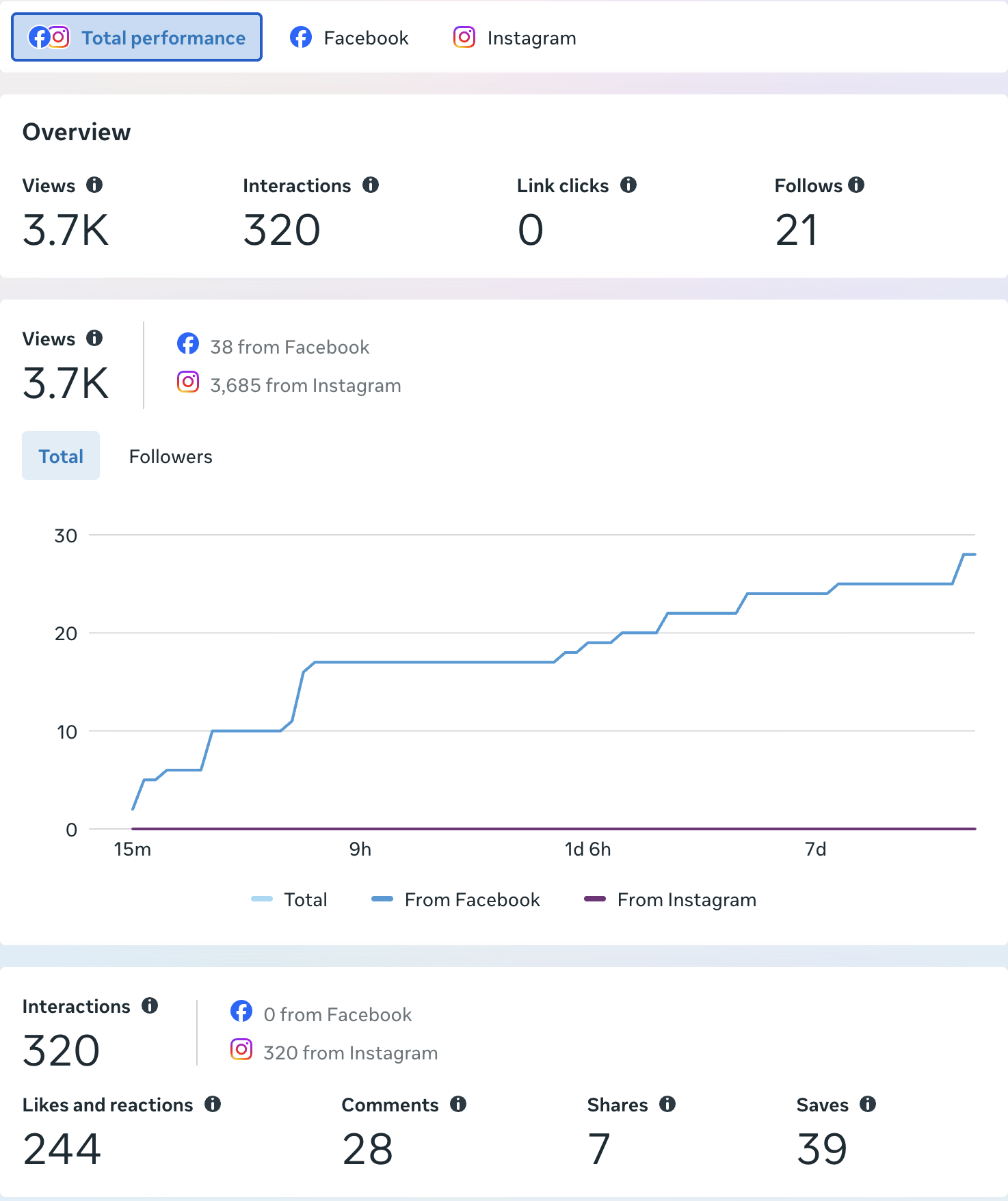
| Instagram — A. Cakes' post | 3,685 views · 320 interactions · 39 saves · +21 followers |
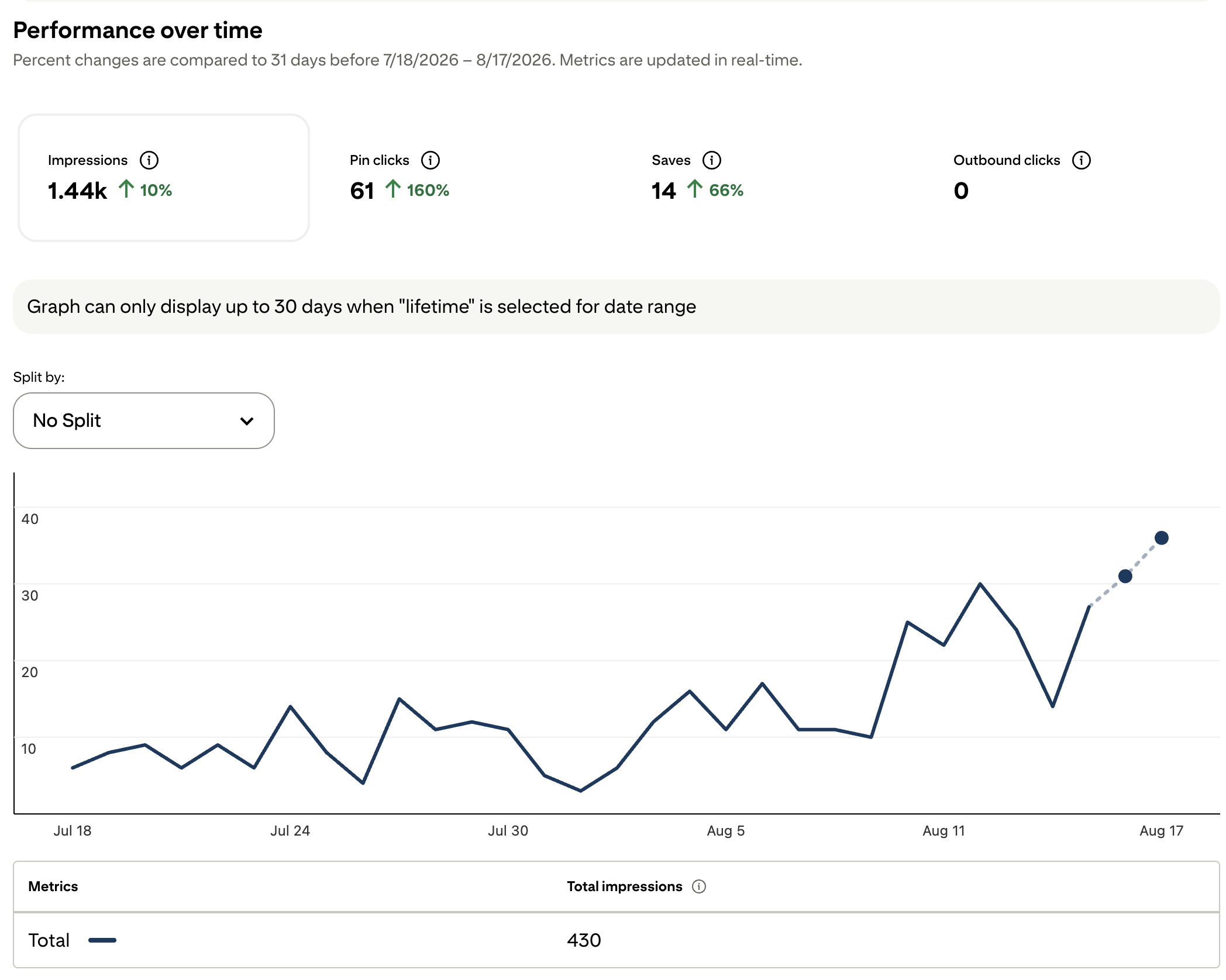
| Pinterest — A. Cakes' pin | 1.44K impressions · 61 pin clicks (+160%) · 14 saves (+66%) |
- Earned, not bought. Editorial publication is third-party proof of authored work — placing A. Cakes among the few Arizona cake artists with a magazine feature, which is what separates a preferred vendor from a recommended one.
- In front of the exact buyer. Rocky Mountain Bride reaches a wedding-planning audience that's 45% aged 25–34 with 67% of readers engaged — the same couple profiled in the pitch deck.
- Credibility you can hold. The issue is printed 110,000+ times a year and stocked nationwide — Walmart, Barnes & Noble, Hallmark, Indigo — so the feature lives on physical shelves across the US and Canada, not just a feed.
- The magazine's channel did the heavy lifting. RMB's own reel pulled 12K views and 8.4K reach — roughly 3× the brand's own post — which is the entire point of earning placement on a bigger, on-target audience.
- Still working a year later. The Pinterest pin keeps compounding — pin clicks up 160%, saves up 66% — the kind of evergreen discovery most social work never earns.
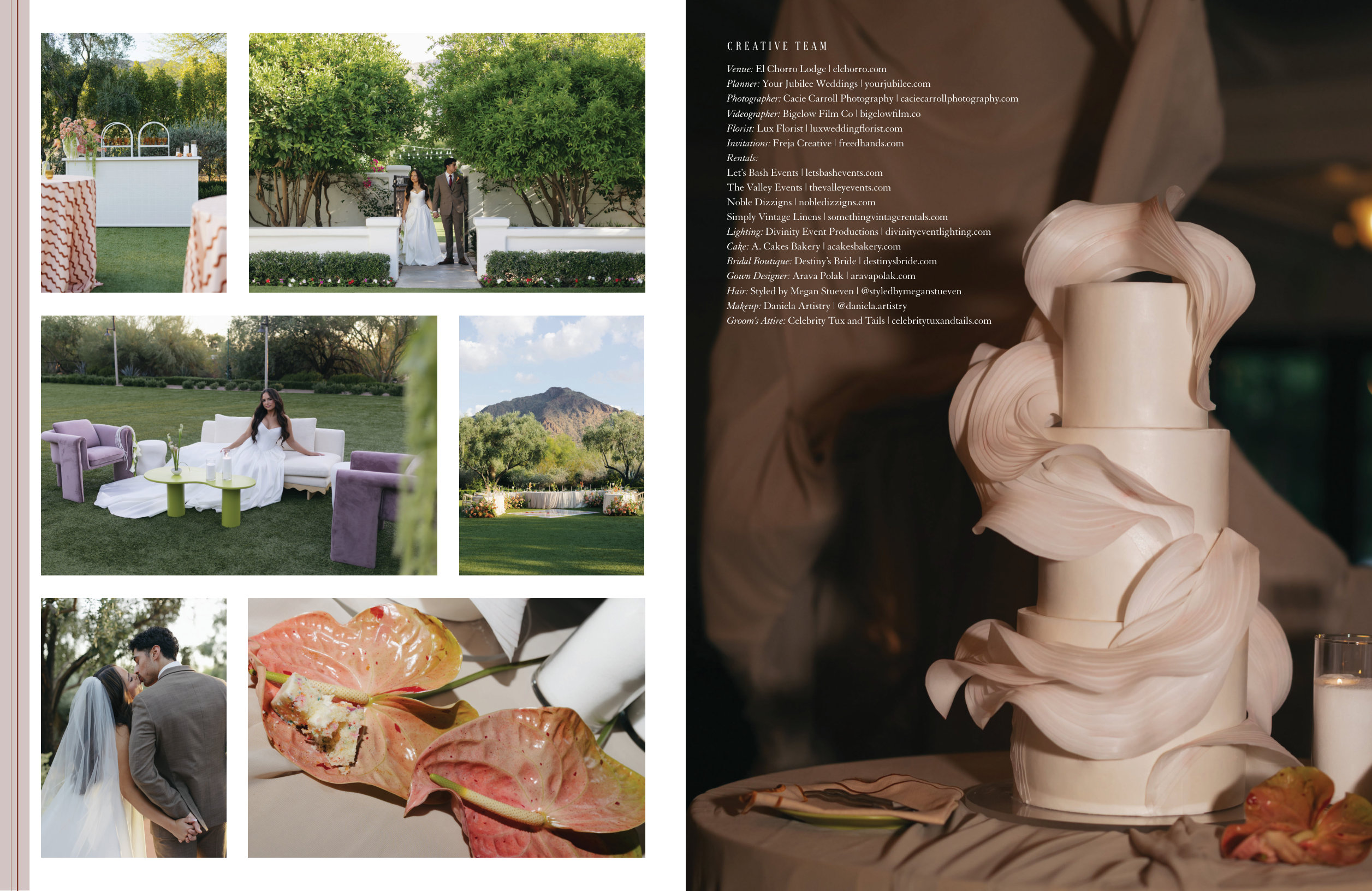
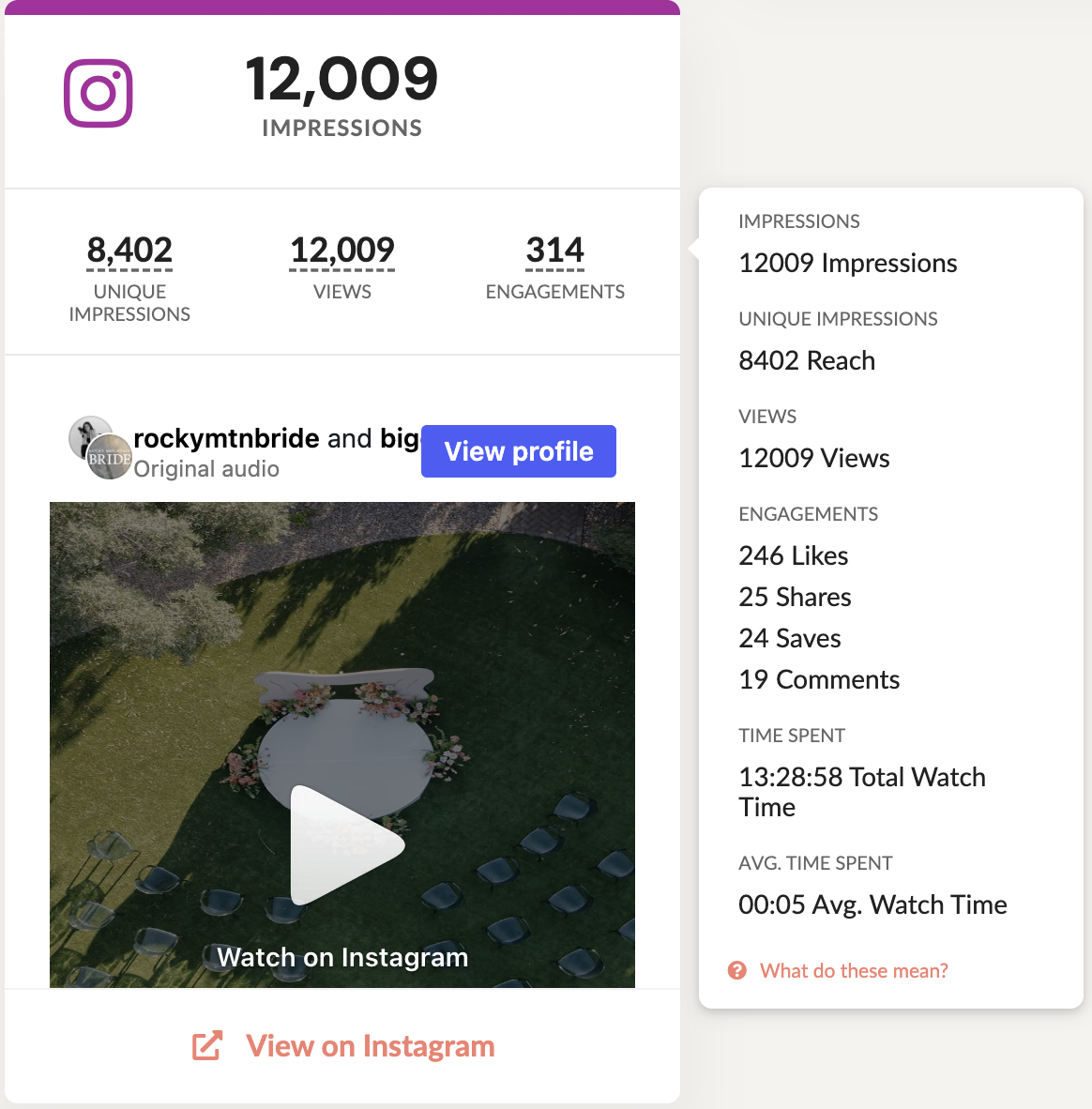
Content Creation Showcase
Like most bakery accounts, A. Cakes' feed leaned on polished, static product photography — beautiful cakes, styled tablescapes, finished-product shots. That content performed steadily, but it wasn't what drove the account's biggest engagement spikes.
Three creative lanes consistently outperformed standard product posts:
Founder-voice storytelling
Personal, first-person essays from the baker herself — client stories, small-business lessons, honest reflections — shared as reels rather than static captions.
Relatable, text-overlay humor
Short, funny, text-driven moments of everyday baker life (kitchen chaos, offhand jokes) that invited comments and shares.
Process & reveal
Behind-the-scenes builds and reveals — tasting boxes, long-table installs, drop-string cake reveals — that gave followers a reason to watch to the end.
Every top-performing piece paired a personal or process-driven hook with an authentic, unpolished tone — a deliberate contrast to the account's more curated static posts, and a reminder that "behind-the-scenes" and "in her own voice" content consistently earned the highest engagement.
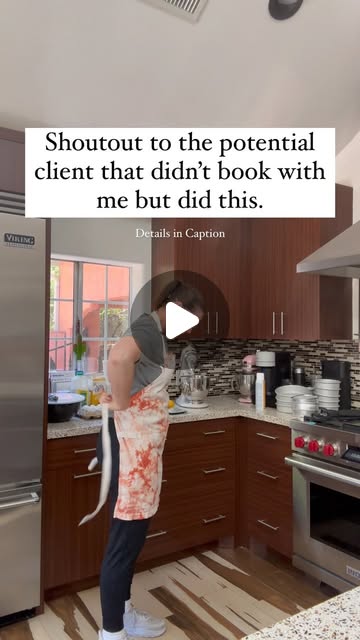
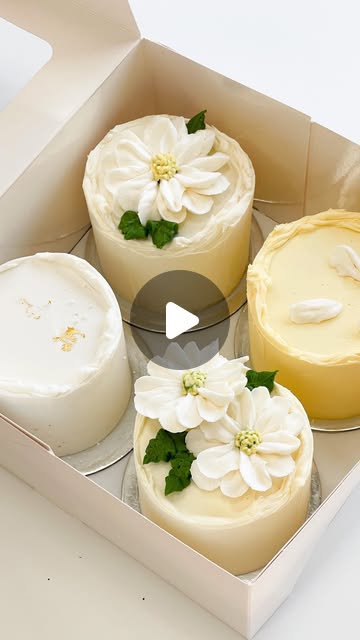
Three of the top-performing pieces — tap to watch on Instagram:
| Content | Format | Likes | Comments | Views | Saves |
|---|---|---|---|---|---|
| Cake tasting box walkthrough | Process / Reveal | 4,161 | 35 | 39K | 211 |
| "The client I never booked" essay | Founder-Voice Storytelling | 2,979 | 50 | 581K | — |
| Wedding dress fabric painting | Founder-Voice Storytelling | 580 | 11 | 54.9K | — |
| "Life is hard, start a business" | Founder-Voice Storytelling | 376 | 7 | 5.8K | 34 |
| Fruit-table long cake, BTS build | Process / Reveal | 294 | 33 | 4.6K | — |
| "Life of a home baker" fridge moment | Relatable Humor | 304 | 6 | 8,132 | 19 |
| "Butterfly effect" story | Founder-Voice Storytelling | 580 | 11 | 55K | 13 |
| 16-foot cake, real wedding | Real Wedding Moment | 233 | 29 | 18.6K | — |
Shares and reposts amplified the top posts further — the 16-foot cake reel earned 52 shares, and "Life is hard, start a business" drew 13 reposts. Figures reflect engagement on live Instagram posts at time of research.
Paired with the account's organic-growth case study, this shows two sides of the same strategy: the analytics prove the growth, and this breakdown shows exactly what kind of creative work earned it — founder-voice honesty, humor, and transparent process over polished perfection. From an account of roughly 6,655 followers, these posts routinely reached far beyond the follower base — the top reel alone pulled 581K views, nearly 90× the account's size.
Golf Influencer Campaign
Experience Jackson — the destination marketing organization for Jackson, Michigan — wanted to be known as a golf destination, but didn't have the content to prove it. They had the courses; what they lacked was compelling, on-course footage and a way to reach travelers who plan trips around golf. They came to me wanting to try influencer marketing, with no existing playbook for it.
Golf creators solved two problems at once. First, they'd produce real content at the exact courses Jackson wanted to spotlight — footage the DMO simply didn't have. Second, I chose creators building a broader brand around blog content that had already been republished by larger golf publishers, so the reach would extend well beyond their own followers. Then I built the deliverables as a full content mix — YouTube, Instagram reels and posts (personal and branded accounts), a blog, and an email newsletter — so a single trip would hit every audience segment Experience Jackson wanted, on the platform each one lives on.
- Approached by Experience Jackson to launch their first influencer effort — I built the concept from scratch
- Sourced and vetted two golf influencers whose audience and blog reach fit the destination-golf goal
- Wrote the contracts and deliverable terms across reels, posts, YouTube, blog, and email — personal and branded accounts
- Built the 3-day itinerary — golf at multiple local courses plus "tourist in Jackson" experiences — refined and approved with Experience Jackson and city partners
- Ran content approvals on every deliverable to keep it on-brand for the destination
- Delivered the whole campaign on a $5,000 budget, stretched with city-partner support
| Metric | Result |
|---|---|
| Content produced | Nearly 30 assets — a YouTube video, 12 reels, 12 posts, 2 blogs & 2 email newsletters |
| Total views | 250K+ across all campaign content |
| Click-through rate | 34% across the campaign's platforms |
| Engagement | 13% engagement rate · standout posts topped 1,500 likes |
| Creator reach | 75K+ Instagram followers · 5K blog visits/mo · ~5K YouTube views/video |
| Budget | $5,000, extended with city-partner support |
- A content library the DMO never had. The whole point was on-course footage at the exact courses Jackson wanted to spotlight — assets Experience Jackson can keep reusing long after the campaign ended.
- Reach that traveled further than the follower count. Because the creators' blog work had already been republished by larger golf publishers, the campaign extended well beyond their own 75K+ followers.
- Numbers most campaigns never see. A 13% engagement rate and a 34% click-through rate are far above the norm — a sign the golf-traveler audience was exactly the right, high-intent match for a golf destination.
For a tourism board's first influencer campaign — built from scratch on a $5,000 budget — this delivered a full content library, a quarter-million views, and engagement and click-through rates most campaigns never touch, while giving Experience Jackson exactly what it set out to prove: that Jackson is a golf destination worth traveling for.